
Driving lights
2024-01-15
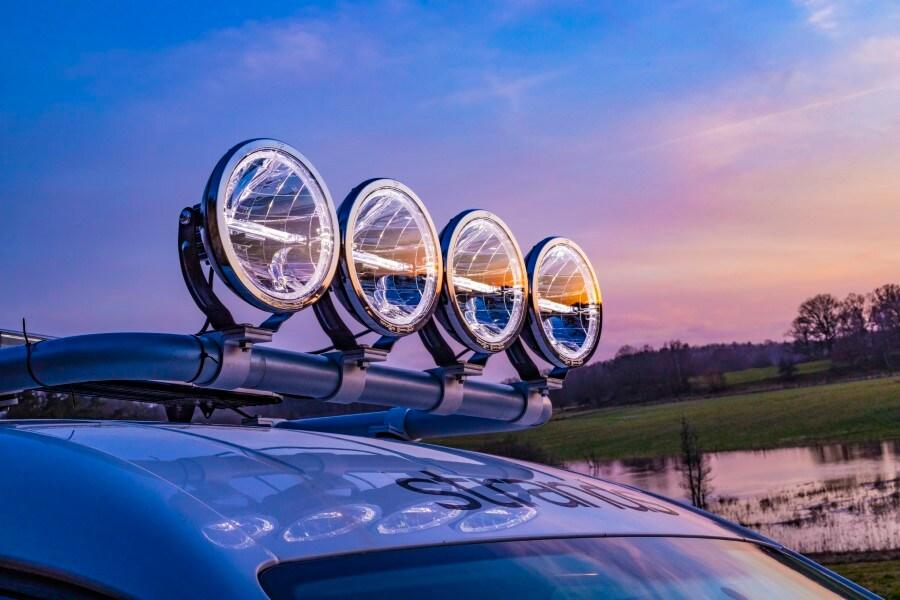
What is needed for the installation of driving lights?
We offer all the accessories you need to mount the lights in the best possible way. Auxiliary light holders are available for two or three auxiliary lights. The holder is placed behind the licence plate and then the lights can be mounted and adjusted. Wiring kit connects from the lights to the battery to get control current so that the auxiliary lights are activated together with the main beam. Top brackets are available for two or three auxiliary lights. They are screwed to the lights and the vehicle (usually on the grill) to stabilise the lights. The struts prevent the lights from changing position in case of vibration, or from vibrating so much that the lamp breaks. The universal arch serves the same purpose as the auxiliary light holder, but is more appealing when the auxiliary lights are mounted on an aluminium arch. If you don't feel handy enough to install them yourself, most workshops offer installation assistance.
Tips for better light
Replacing lamps When it's time to change your car lights - make sure they are changed in pairs. This is to avoid uneven lighting which in turn leads to reduced visibility.
Auxiliary lights Anyone who drives a lot in the dark should be no stranger to this. It is cheap insurance. The field of vision is much wider and also helps to detect animals on the road or at the roadside.
Never touch the glass Halogen lamp glass is sensitive and should never be touched with bare hands. Grease from the skin is transferred to the lamp, causing it to overheat and shortening its lifespan.
LED, Xenon and Halogen
The development of LED technology has been astonishing in recent years. The previously dimmer LEDs have been developed and are now much brighter than traditional filament lamps.
Supplementing the main beam with auxiliary lights has been popular for many years. In the 1990s, xenon models were introduced. They could produce about twice as much light as the halogen models and the significantly cooler glow was appreciated by many, being more comfortable for the eye. But the technology has some disadvantages (expensive spare parts, long ignition time and more sensitive to vibrations). There have been no major developments since then, until now. Now there is a big difference between a simple halogen light and modern LED lighting.
The main advantages of LEDs compared to xenon and old halogen lamps are:
Instant on. Short ignition time of a few hundredths of a second.
Low power consumption.
Long operating time. LED exterior lights have a lifespan of up to 30,000 hours. In comparison, the lifetime of 55W H3 halogen is 400 hours and xenon is 2500 hours.
Impact resistant. Many LED luminaires have a compact and very robust design that can withstand shocks, impacts and water. The lenses are often made of durable polycarbonate which resists stone chips.
Maintenance-free. Easy to both use and connect.
Low heat generation.
There is a very wide range of auxiliary lights on the market, ranging from a few hundred kronor to several thousand. If you have not previously had any extra lighting at all, most of them, whatever you choose, provide a large and substantial reinforcement and thus increased safety for the driver. A headlight that illuminates 250 metres complements the regular high beam perfectly. Proper lighting is a supplement that can save you from hitting a moose, deer, jogger or cyclist without lights. At 90 km per hour, you can cover 25 metres in one second. It's important to recognise things in time - auxiliary lights can save lives!
E-approved auxiliary lights and lighting
Since 1 January 2005, all vehicle lighting, including auxiliary lights, must be EU-approved. This means that those who want to drive legally must choose lighting that is E-marked. If you have a car that is older than 1 January 2005, you can claim that the auxiliary lights were installed before then, the rules do not apply retroactively. But it is up to each individual how they relate to the regulations.
The e-labelling applies to both luminaire with light source and peripheral equipment, everything must be e-labelled as a whole. The e-labelling indicates not only an approval in terms of light, but also what it is approved as. If you look at the lens of the headlight on a modern car, there must be a designation ("e-XXXXXXXX" X = digit) that certifies which lighting source (Xenon, halogen, LED) is in the luminaire and what function they have. So, just because a lamp is E-approved, you can't use it for anything. Incorrect combinations are illegal. For example, an E-marked side marker lamp cannot be used as a front position lamp, only an E-marked approved position lamp may be used.
The e-labelling thus certifies that the lighting is adapted for the right purpose. For example, the most extreme auxiliary lights may not be approved because they have passed the limit of what is reasonable. The light can be incredibly bright and if you happen to look into one at too close a range there is a risk of eye damage. Nobody wants to meet a car with such lights on a hillside. This is why lamps with this range are not E-marked.